
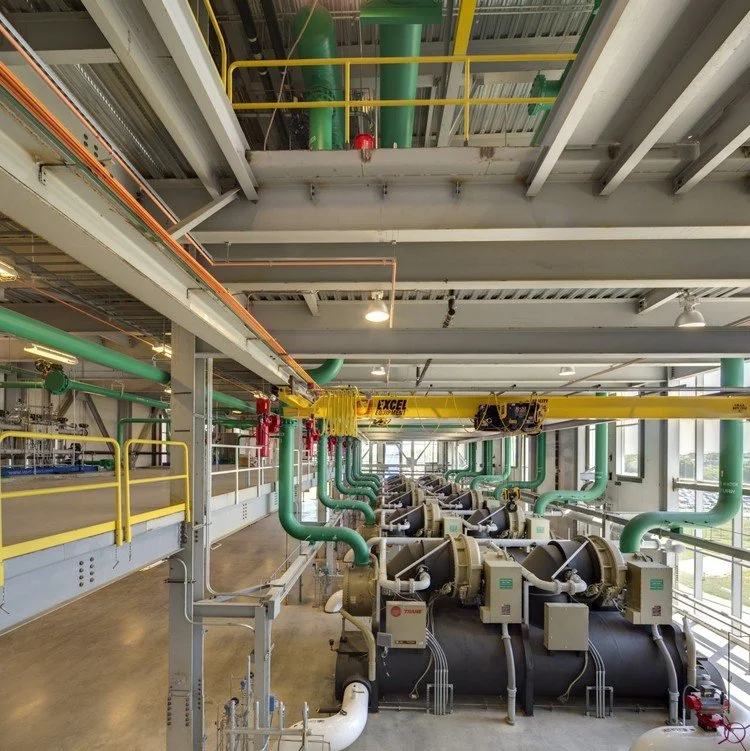
Why a Large Chiller Plant Needs a Customized Sequence of Operation, Part 1
A large central chiller plant is not simply a collection of chillers, pumps, cooling towers, and valves. It is an integrated energy system in which every component affects the performance of the others. For this reason, relying on a generic Sequence of Operation (SOO) can significantly limit efficiency, reliability, and overall plant performance.
A generic sequence may define basic functions: start a chiller when load increases, stage another chiller at a certain threshold, reset chilled-water temperature, or vary pump and cooling-tower speeds. While these strategies may be technically correct, they do not necessarily reflect how a particular plant should actually operate.
Every large chiller plant is different. Chiller sizes and efficiencies vary. Pump curves, piping configurations, minimum chiller flows, cooling-tower performance, building load profiles, climate conditions, equipment redundancy, thermal energy storage, and utility rate structures can all influence the optimal operating strategy.
A customized Sequence of Operation considers these characteristics and defines how the plant should operate as a complete system.
For example, the most efficient decision is not always to stage chillers based simply on percentage load. Two chillers operating at part load may sometimes consume less total energy than one chiller operating near full capacity. Likewise, lowering condenser-water temperature may improve chiller efficiency but increase cooling-tower fan energy. Increasing chilled-water differential pressure may satisfy remote coils but unnecessarily increase pumping energy.
The correct sequence must therefore consider total plant energy, not just individual equipment operation.
This becomes even more important in plants incorporating variable-primary pumping, unequal-size chillers, thermal energy storage, waterside economizers, or complex electrical demand charges. In these facilities, seemingly small sequencing decisions can have a significant impact on annual operating cost.
A customized SOO should also define how the plant responds to real operating conditions: low loads, rapid load changes, equipment failures, sensor problems, minimum-flow limitations, lead/lag rotation, equipment availability, and abnormal conditions. These details are often missing from generic sequences but are essential to reliable operation.
Most importantly, the Sequence of Operation should not be treated as static programming instructions. It should represent the engineering logic for operating the plant at its highest practical efficiency while maintaining reliability and occupant requirements.
For a large central plant, controls cannot compensate for an inadequate sequence. Even the most sophisticated Building Management System will faithfully execute inefficient logic if that is what it has been programmed to do.
A generic sequence tells the plant how to run. A customized sequence tells the plant how to perform.
For complex chiller plants, that distinction can translate directly into lower energy consumption, reduced peak demand, fewer operating problems, longer equipment life, and substantially lower lifecycle cost.
Michael Dadjou, PhD, CxA, LEED AP is a senior forensic and energy engineering professional with more than 30 years of experience evaluating, commissioning, troubleshooting, and optimizing complex building mechanical and energy systems. His expertise encompasses forensic investigation of HVAC and control-system performance, energy engineering, building commissioning, energy modeling, system optimization, and the identification of design, installation, operational, and control deficiencies. He also serves as the managing principal of alliancePROJECT.
Dr. Dadjou combines engineering analysis with extensive field experience to determine root causes of performance problems and develop practical corrective solutions that improve energy efficiency, reliability, and long-term facility performance. His experience includes major and technically complex facilities such as the Los Angeles Convention Center, Jet Propulsion Laboratory (JPL), Los Angeles Unified School District, Disneyland, Honda Center, NBC Studios Burbank, Hyperion Water Treatment Center, Fort Irwin National Training Center, Marine Corps Base Camp Pendleton, and Naval Air Weapons Station China Lake, as well as numerous municipal, institutional, commercial, and industrial facilities throughout Southern California and across the United States.